

Getting ESL students to speak was the ultimate challenge this year. Many were working at different language levels, most were never expected to produce English in their mainstream classes, and some had learned helplessness.
And as the English teacher, I felt like I was constantly pulling teeth. Have you been there?
That’s one reason why I created more visually based ESL board games for my students. The benefits have been many, but here are my top 5 reasons on why I love having images + vocabulary and grammar board games on hand, all year long.
1. ESL Board Games Support Essential Vocabulary Learning
Visual ESL Board games are especially effective for vocabulary learning because they give students repeated, meaningful exposure to new words in grammatical context. Students see, hear, and use the targeted vocabulary multiple times during gameplay. Everyone actually wins.
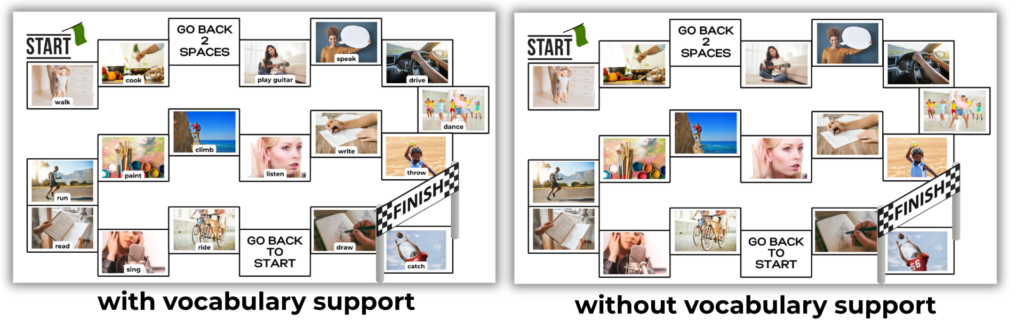
I also include both embedded vocabulary versions and versions without vocabulary support to allow for different levels of scaffolding. For my students who struggle, this helped them continue to learn the vocabulary they needed. For my students who were ready for a challenge, images without the text helped them recall the vocabulary and put it into long-term use.
2. They Develop Grammar Accuracy and Fluency in Speaking
Language learners need repetition to build fluency, but repetitive drills with the teacher can quickly become the teacher doing all of the speaking.
ESL board games allow all students to access the language they need and use the same grammar structure or sentence patterns multiple times without the practice feeling repetitive. Students may answer similar questions dozens of times during a game, but because each turn focuses on a different vocabulary word, engagement stays high.
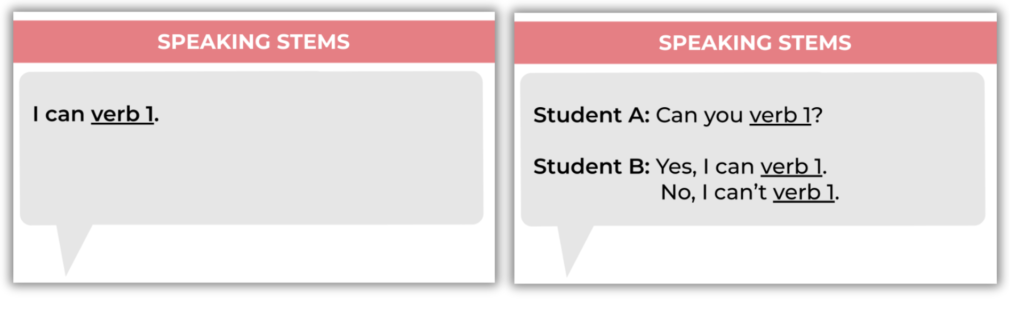
It turns drill-and-kill into drill-the-skill, and that repeated exposure helps grammar stick. So how do you ensure students are being accurate in their output? I gave my students speaking stems depending on their level. Here are the examples from the action verbs board games.
3. Visual ESL Board Games Support Mixed-Level ESL Classes
One of the biggest challenges in ESL classrooms is teaching students with different language abilities at the same time. If you have ever taught a beginner ESL class, you know that beginners can have huge gaps in language abilities.
Visual ESL board games naturally support differentiation because teachers can:
- focus on different levels of grammar use within a vocabulary set
- pair stronger students with beginners within a vocabulary set
- modify speaking expectations with the speaking stems
- set up stations for different grammar concepts
Some students may practice identifying vocabulary with pictures, while others recall vocabulary. Some may practice the affirmative form of the grammar, while others practice both the affirmative and negative forms as seen below. Some students may have short conversations where one asks a question, and the other responds.
That flexibility makes board games useful across the gaps that exist within a beginner ESL level.

4. Students Practice Real Communication Skills
Many ESL activities focus heavily on written work, but board games encourage authentic speaking and listening practice.
During games, students must:
- listen carefully
- ask and answer questions
- take turns speaking
- respond in real time
As students become familar with the vocabulary and grammar, these conversational skills help to finish building confidence in everyday English communication.
5. ESL Game Boards are Easy for Teachers!
This reason isn’t connected to speaking success, but another reason teachers love ESL board games is simple: they are practical. Many games require very little prep. All 46 board games in my bundle print on a standard-sized peice of paper, and once laminated, they can be reused all year long for:
- students who finish work quickly
- make-up days where some students are all caught up
- testing days where students are tired, but need to stay engaged
- summer school activities to gte students warmed up
- substitute plans
And unlike some activities that only work once, students are often happy to return to the board games and pick new versions as their English fluency developes. Everyone wins!
Final Thoughts
Bonus: ESL board games are an easy way to engage students, and they also help build classroom community. When used intentionally, they can become powerful language-learning tools that help ESL students build vocabulary, grammar fluency, speaking confidence, and communication skills.
Most importantly, they help students use English in a way that is enjoyable, and that kind of meaningful practice is what truly supports language growth.
PSSST: Want more ways to engage students? Check out the strategies I share in my blog!