

When I first started teaching EFL in Istanbul, I was expected to develop students’ listening skills simply by teaching in English. That part was easy. The challenge was that hearing and listening are not the same skill.
On top of that, our packaged curriculum only included one short listening activity per unit. If I wanted students to practice real, active listening, I had to create it myself. Most days, that didn’t happen. I taught in English, used the CD from time to time, and moved on.
Later, teaching ESL in Texas gave me more flexibility to intentionally build listening into my lessons, but time was now even more limited. Any listening activity had to take less than 10 minutes to create.
And so, quick scripts were born! A short, targeted activity that could be used almost immediately. Simply print.
How Do I Start with Quick Scripts?
Before we start with why quick scripts work, let me explain why they are such an easy listening activity to use.
- First, determine what skill you want to focus on. I usually pick a grammar concept that I want students to hear naturally or content vocabulary in context.
- Next, use what you have or have access to. I have used text from workbooks, worksheets, and I will admit, I have asked AI to create simple texts too. Copy and paste the text into a Word Document.
- Keep the original text for yourself. That is your script. Paste it again on page 2 and replace the grammar concepts or content vocabulary with a blank.
- Print page 2 for students. They will listen for what goes in the blank. That’s it!
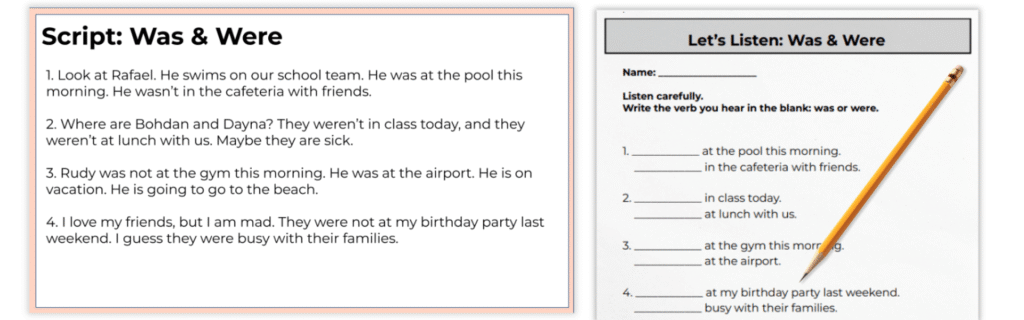
This is the simplest version of quick scripts, and you can see an example from my simple past tense listening activities below with the teacher script on the left and student work on the right (and this looks polished- yours doesn’t need to!)
1. They Teach Students How to Listen
Many English learners spend their day hearing English, but again, hearing does not equate to listening. Quick scripts, on the other hand, encourage students to listen for a specific purpose. Depending on your objective, they might listen for a grammar pattern, content vocabulary, or key details.
This intentional focus slows students down and encourages them to process spoken English rather than letting it wash over them. Over time, students also become more aware of how English is structured and begin naturally understanding patterns they can apply when it is time for them to output.
For example, I want my students to listen for the -s on the third person singular in the simple present tense, so they don’t forget it when they speak. Which actually brings me to…
2. Students Need Input Before They Can Produce Output
One of the biggest mistakes we can make is asking students to produce language they haven’t had enough opportunities to hear. Quick scripts provide the input students need before they’re expected to speak or write.
As students listen, they’re exposed to correct grammar, sentence structures, and academic vocabulary used in context. Instead of memorizing isolated rules, they hear language functioning the way it’s meant to be used.
This exposure builds familiarity and ultimately confidence. When it’s time for partner discussions or classroom conversations, students aren’t trying to use language they’ve only read on a worksheet. They’re using language they’ve already heard.
Listening becomes the bridge between understanding a new language and confidently using it. And now, my favorite reason to use quick scripts is…
3. This Listening Activity Saves Teachers Time!
Teachers often spend valuable planning time searching for the perfect listening activity or the perfect video for listening, only to find the grammar or vocabulary is too advanced or the video is simply longer than the time they have.
With a quick script, you control everything.
You choose the grammar concept or content vocabulary. You pull it from materials you already have, or you tell AI exactly what language to use and how much of it to use.
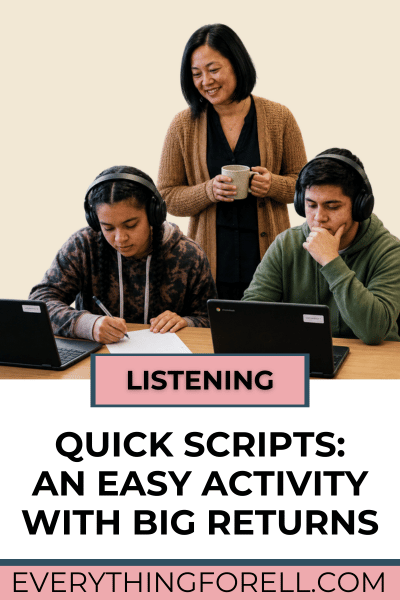
In classrooms with 1-to-1 devices, this listening activity becomes even more powerful. Teachers can quickly post the passage digitally. I mean, have you see what Descript can do? This allows students to listen and respond independently. And here is the best part: students rarely bother me when they are plugged in and completing a listening activity on their own.
In classrooms without device access, quick scripts work just as well in print form. Teachers can simply hand out the student doc with the fill-in-the-blanks, read the original passage aloud, and have students complete their responses on paper.
In less than 10 minutes, you can create a listening activity that is perfectly aligned to your lesson objective and differentiated for your students.
Small Strategy, Big Impact
Listening is an often overlooked language skill, yet it supports the areas of writing and speaking. When students learn to actively listen for grammar patterns, vocabulary, and sentence structure, they become more confident communicators. They begin to recognize language before they’re expected to produce it, making speaking and writing feel less intimidating and more successful.
The best part is that this doesn’t require spending all your planning time trying to create a a listening activity. Hot tip: keep a quick script template to work even more quickly.
Want to see what mine look like? I’ve added images instead of text to some to keep the cognitive load even lower for beginners. Check out my FREE number listening activities–
👉 Want more ESL strategies? Check out my blog!