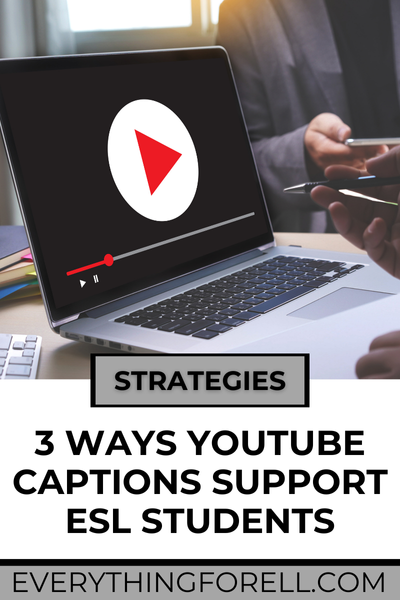


If you use YouTube videos in your classroom, you’re probably aware of how powerful visuals can be for language learners. But one simple adjustment often goes overlooked: changing the YouTube captions into a student’s native language.
For multilingual learners, this small change can dramatically increase comprehension, confidence, and engagement, regardless of their English language level. Newcomers benefit from being able to pick up on the main idea and some details of the content, and more advanced students are able to begin to understand academic vocabulary in context.
And here is the best part: this takes less than a minute!
Check out how to change the YouTube captions below:
Here are 3 other reasons why this strategy is effective for ESL students.
1. YouTube Captions Reduce Cognitive Overload
When students are learning content and language at the same time, their brains are working overtime. We are asking them to:
- Separate words and assign meaning
- Connect known words in a way that reveals the main idea
- Decode unfamiliar vocabulary
The truth is that if the student doesn’t recognize a majority of the words in English, they will tune out and shut down. It’s not because they are lazy. They are simply overloaded.
Native-language captions reduce that cognitive load. Instead of struggling to understand what is being said, students can focus on:
- Understanding the details of the main idea
- Learning academic vocabulary in context
This doesn’t replace English input, rather it supports it.
2. It Builds Background Knowledge Quickly
Background knowledge is essential for comprehension. When students understand the topic in their native language first, they are far better prepared to engage with it in English later.
Native-language captions help students:
- Grasp key concepts and their details quickly
- Learn unfamiliar topics without language becoming a barrier
- Participate meaningfully in follow-up activities
This is especially powerful for social studies concepts that are specific to a region, and not necessarily global. For example, my more advanced English students tend to worry most in classes like U.S. History and U.S. Government. In courses like these, short videos that explain the main idea in English are useful, especially if students can also read about it in their native language.
3. It Increases ESL Student Confidence and Participation
Native-language YouTube Captions captions can help reduce anxiety and “opt out” for ESL students. Students who understand even a little bit of what’s happening have a greater reason to participate which looks like:
- Answer questions in various ways: thumbs up, multiple choice to
- Take risks speaking or writing with sentence stems and
- Stay engaged during future instruction
When to Use and Not Use Native-Language YouTube Captions
These videos work best when you are building background knowledge and exposing students to new content. They especially work best in a mainstream classroom where the teacher may not have the resources or time to scaffold every aspect of a lesson to accommodate linguistic needs.
Times to shift away from them is when a classroom or lesson is already scaffolded for English language learning, and the objective of the lesson is to have the student listen for details, specific English vocabulary, or uses of English grammar.
Changing closed captions to a student’s native language takes less than a minute, but the instructional impact can be significant because you are telling that student that they are included, they matter, they are expected to be a part of the learning process in that room.
What an easy way to get an easy win in the class.
Need more strategies? Check out easy-to-implement ideas here.
Need more easy wins? I have an entire store full of them! Click here or the banner below!