


Every year, the STAAR English 1 and English 2 exam is released and teachers face the same question:
Where should we focus our limited time to make the biggest gains on STAAR?
To help answer that, I analyzed the released 2026 STAAR English I and II exams. My goal was simple: find out which TEKS show up most often so we can target reading instruction where it counts.
The TEK We Can Bet On
Since the first STAAR exam in 2011, TEK 4H has appeared anywhere from three to five times per test. This standard asks students to “synthesize information from two texts to create new understanding.” In my district, we call these “cross-over” questions, where students analyze the similarities and differences of two texts from different genres.
In both 2025 and 2026, this section of the exam included four questions, meaning TEK 4H accounted for roughly 13% of the reading exam. We know this will be asked, so it only makes sense to practice this TEK all year or at the very least, review it before the exam with short texts.
Note: the pairings for these texts change often. In 2025, English 1 had a short story + poem. In 2026, English 1 had an argumentative text + poem. The key is to get your students used to analyzing two texts. I will write these cross over question for texts that are also within the same genre, so that students become accustomed to looking at how characters, dialogue, tone, and theme can be similar or differ.
Now, what about the other TEKS?
STAAR ENGLISH I TEKS
I wanted to compare 2026 with 2025 and see what patterns emerged. Take a look below:
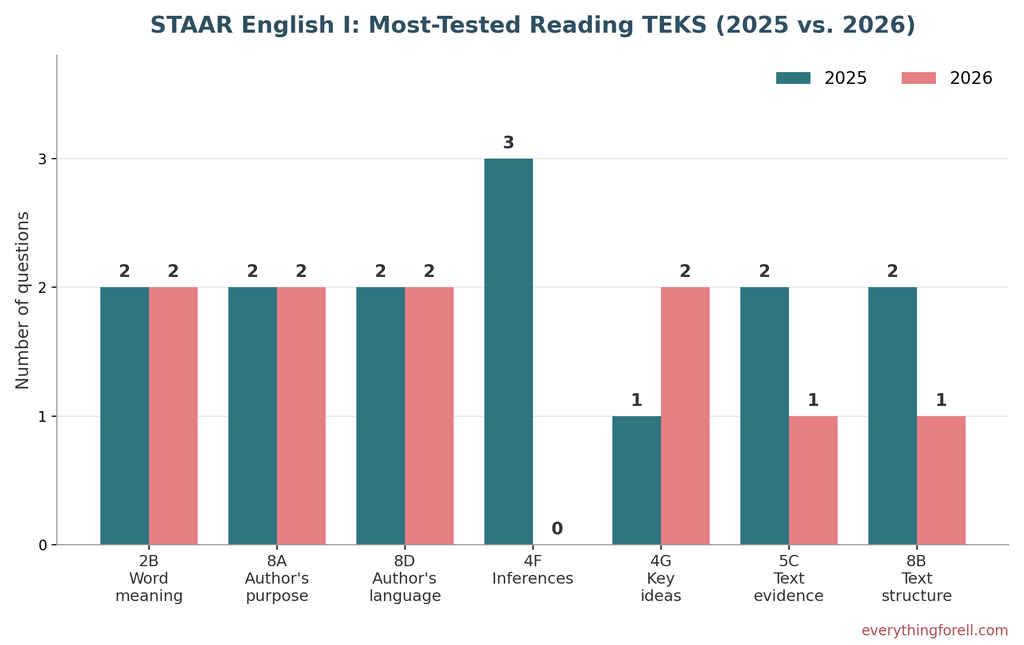
The biggest swing? TEK 4F: inferences was asked 4 times in 2025 and not at all for the English 1 in 2026! Does that mean to quit teaching it? I wouldn’t, but it definitely is interesting.
So what took over? Outside of 4G, nothing in particular. The exam seems to have balanced itself out just a little more, but I was really pleased to see that we still have 4 consistent TEKS:
- 2B: Denotation and connotation
- 8A: Analyzing the author’s purpose
- 8D: Analyzing the author’s use of language
- 4G: Evaluate details to determine key ideas
STAAR English II TEKS
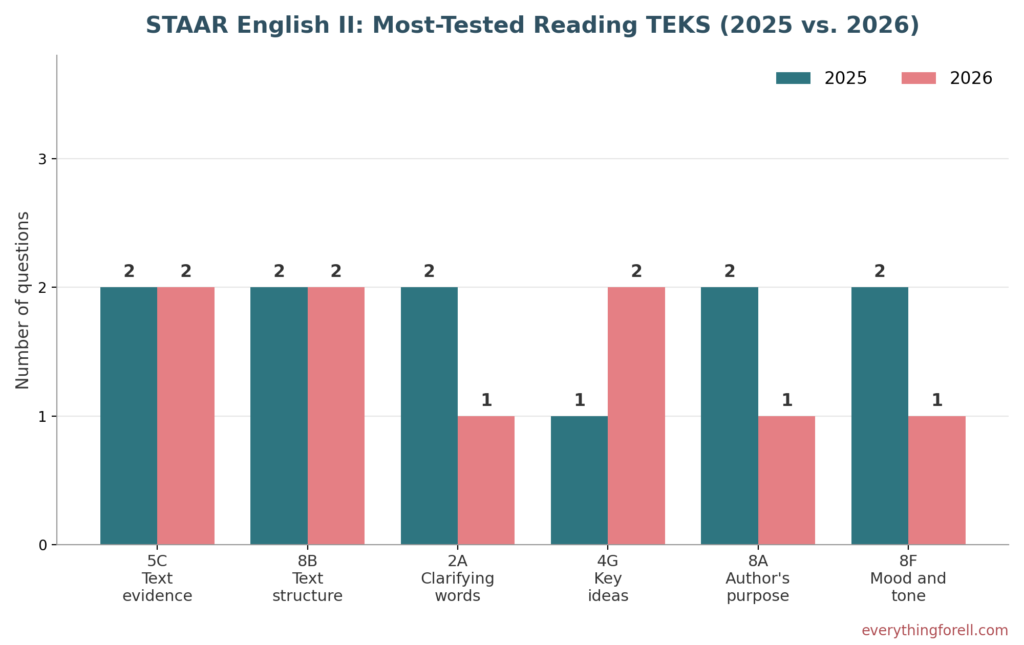
Again, I was really pleased to see not much of a change from 2025. Take a look at what stayed consistent:
- 5C: Using text evidence to support an answer
- 8B: Analyzing text structure
With an increase in (again):
- 4G: Evaluate details to determine key ideas
And one less question in:
TEKS That Appeared on Both English I and II
If you teach both English I and English II, then I would start here as these TEKS have been asked 2x in either 2025 or 2026 on both STAAR exams.
- 4H: Synthesize information from 2 texts
- 5C: Using text evidence to support an answer
- 8A: Analyzing the author’s purpose
- 8B: Analyzing text structure
- 4G: Evaluate details to determine key ideas
And note that for the last few years, it seems pretty consistent that when it comes to vocabulary:
- English I leans towards 2B: Denoative and connotative
- English II leans more 2A: Using print or digital resources to clarify the meaning of a word
❤️ A Realistic Note for Retesting
I never advocate for teaching to the test, but let’s be honest, when you’re preparing re-testers or are in charge of small-group pullouts, that’s exactly what you need to do.
That’s why I’ve created focused worksheets that target TEKS 2B, 4F, 4H, and 8A that are perfect for those short, high-impact review sessions that build the right habits without burning out your students. And guess what? More worksheets are on the way and will be added to the bundle above! Buy now, and get the future additions for FREE!
Additionally, it’s not too late to start bringing in these high-frequency TEKS into your regular instruction. You can:
- 👉 Use STAAR-style question stems in reading lessons. Pssst. These are editable and FREE for those on my email list, if you would like to join our team!
- 👉 Create bell ringers or exit tickets for daily spiral review.
Final Words…
I hate the STAAR exam. I have seen it smash a student’s confidence more than once. Every year, my classroom has some tears because my students set really high goals for themselves, despite only knowing the English language for a few years.
The STAAR exam is the hardest EOC. There’s no debate on this. And after 13 years of guiding students through it, I don’t believe it is getting any easier. So let’s be intentional with our time, give ourselves some grace, and remind our students that they are SO MUCH MORE than their STAAR score. We got this.
Happy testing!
⭐P.S. If you need more Texas testing support, check out my blog!