

There is something unpleasant about having to interupt my peaceful summer mornings with PD involving a stranger asking me to make a name tent and finger snap when another educator shares an idea.
However, my most recent PD was on the updated ELPS, and I thought I would share what we learned. We spent a little time looking at the changes, and here is what my group noticed:
- The four language levels are now expanded to five
- The ELPS now extend to content area specific skills
- Cognates show up in multiple domains (more on that below)
- The language categories are expanded and renamed as more specific language patterns
I want to spend some time on that last bullet point, the new, specific language patterns. There are some really interesting changes here.
Note: This is my best interpretation of these updated ELPS by looking at the Grade 4-12 Side-By-Side Table, and the Updated ELPS. This information is messy, and my brain is still in summer mode. If you notice errors or see anything I missed, please leave a comment below. Let’s learn together.
Listening ELPS
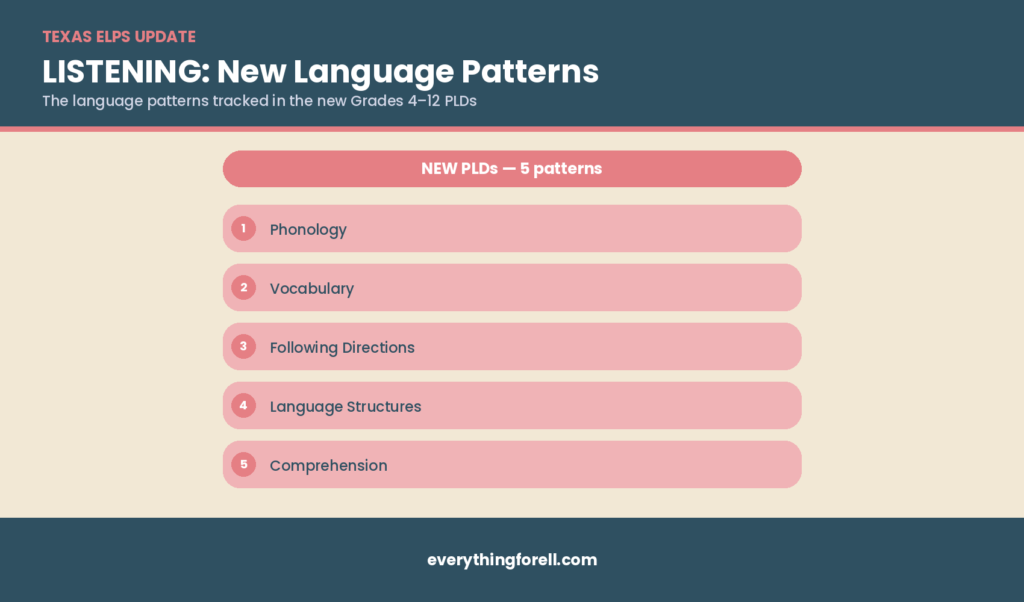
The old ELPS were much broader. For example, one standard asked students to “distinguish sounds and intonation patterns of English with increasing ease.” That’s difficult to measure because it doesn’t explain what “increasing ease” actually looks like in terms of communication modality or language output. Now, the updated ELPS is named phonology and states, “distinguish sounds and intonation patterns by responding with gestures or images, orally, or in writing.” Much easier to see and measure.
Another take away is that the old listening standard asked students to demonstrate comprehension “by following directions, retelling messages, responding to questions, collaborating with peers, and taking notes.” This was one sentence, with five different skills jumbled together. The new PLDs split that into three separate patterns: Follow Directions, Language Structures, and Comprehension. Pick one to work with, not five.
🎯 WHERE I WOULD FOCUS: FOLLOWING DIRECTIONS. From observing and imitating (pre-production) to following multi-steps with repetition (intermediate), I think this is a realistic gain for most EBs to make in a year. Use images in your daily objectives, model the work, and be consistent in learning routines.
Speaking ELPS
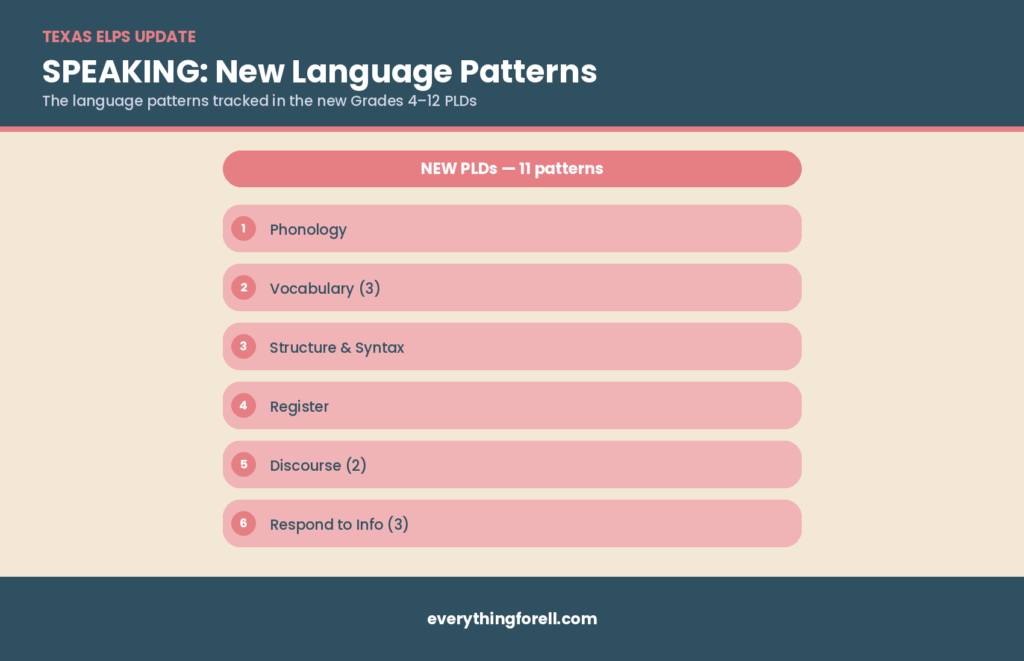
Speaking got the biggest overhaul of any domain. There are now eleven new patterns, with vocabulary splitting into three separate patterns, discourse getting 2 seperate patterns, and responding to information getting 3 seperate patterns.
Now, I am going to say that one of the vocabulary patterns seems redundant. Vocabulary pattern 3, “speak in increasingly complex sentences using content-area vocabulary with support from cognates and Greek and Latin prefixes, suffixes, and roots,” is similar to vocabulary pattern 1, “speak using academic language and collocations…” The redundancy lies in my belief that content-area vocabulary is academic vocabulary. And one more thing…
📢 WHAT IS UP WITH COGNATES SHOWING UP 3 DOMAINS? I get it. Students who speak Latin based langauges like Spanish, French, and Italian are going to be able to grasp academic language more quickly, so utilizing cognates is a win. And I am never going to poop on teaching Greek and Latin roots either because that is how I got a lot of my students to boost their English language comprehension in reading. However, I also serve a population of Vietnamese, Ukrainian, Farsi, Pashto, and Arabic speakers. The cognates for those students are less, so this being a measuring stick within the updated ELPS seems a bit unfair. Ok, off my soap box now.
The two patterns that didn’t really exist before are register (adjusting speech for audience and purpose) and respond to information (answering, retelling, and asking about content).
🎯 WHERE I WOULD FOCUS: ACADEMIC VOCABULRY.
- Focus on 8-10 words each unit and ensure they come up recursively in note and activities.
- Create word walls! There are many Canva templates, like this one, that you can use.
- Create speaking opportunities through bell-ringers and exit tickets where students use the acadmic vocabulary with the support of sentence stems.
- And if students don’t know an answer, point them to alternative, academic responses.
Reading ELPS
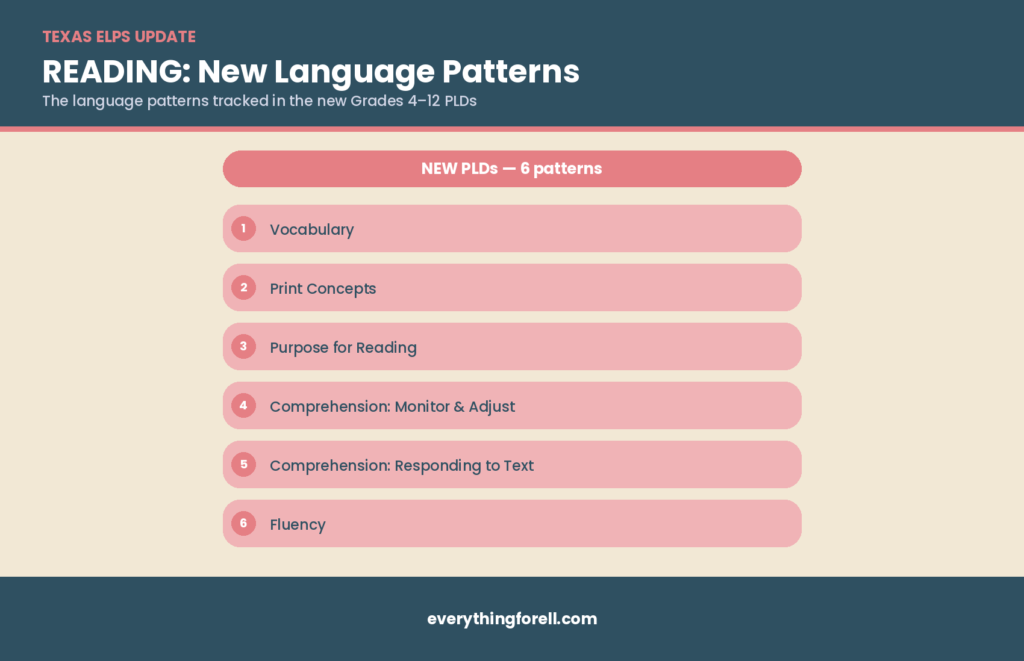
Reading grew from three broad categories to six specific ones. The two new patterns that didn’t really exist before are Print Concepts and Purpose for Reading. Comprehension also splits into two distinct skills: Monitor & Adjust and Responding to Text.
The new reading patterns in the updated ELPS send a message: reading isn’t just comprehension. It’s separate, teachable skills that are just as important as we build reading strength.
🎯 WHERE I WOULD FOCUS: FLUENCY. From “mimic word-by-word during choral reading” (pre-production) to “read in two-word phrases with some three- or four word groupings” (intermediate), this is an easy gain to make during the year. My go-to reading strategy, Drop-In Reading, works perfectly for this.
Writing ELPS
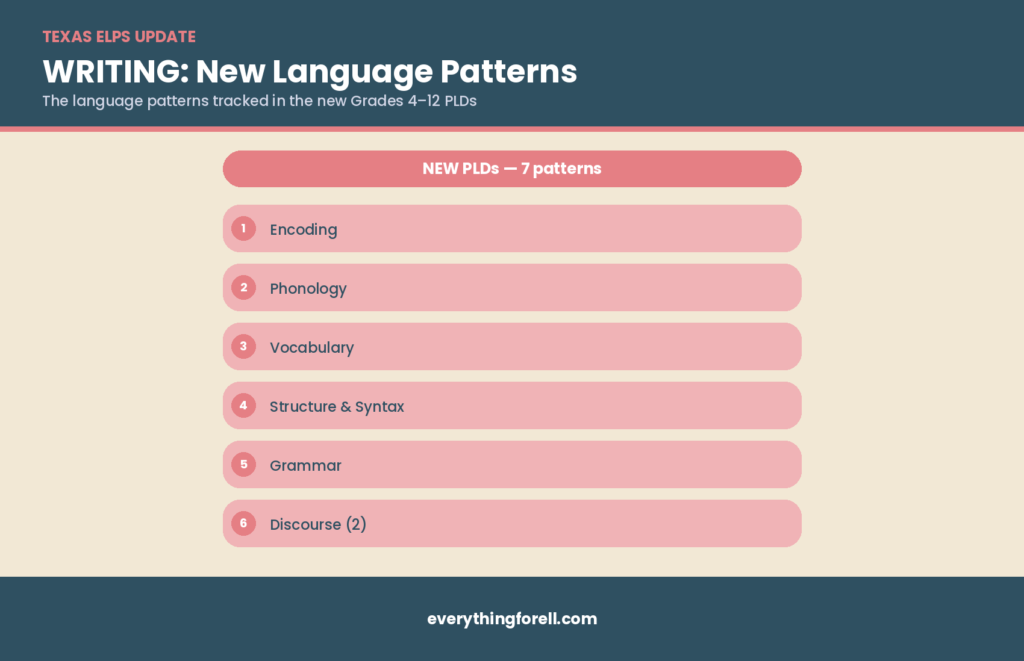
Finally, with the new updated ELPS, writing expanded from three categories to seven, and the big change is Encoding, which is the mechanics of spelling and sound-symbol correspondence. This has been seperated from Phonology and Grammar, and I feel like this is a win because we have had many students who were able to describe, summarize, or compare and contrast through speaking only to be unable to write in English because they could not encode. We need both encoding and phonology!
🎯 WHERE I WOULD FOCUS: GRAMMAR. Getting students to “write phrases using standard English conventions” (intermediate) within a year seems like an easy goal. Simply build in the expectation that students capitalize the first word of a sentence and use correct punctuation. If a student doesn’t, return the paper and have them correct it, or take points off. Consistency is key.
Final Thoughts on the Updated ELPS Language Patterns
Looking at all four charts together, three things stand out:
Speaking has been unserved. Speaking more than doubled its language patterns, from 5 to 11. If you look at the new patterns under the advance speaking category, you will also see “complex sentences” come up a bit. TEA doesn’t want students speaking 40 second on every day topics anymore: the updated ELPS indicate they want robust answers to academic content. Adjust your speaking stems to refect this.
Sound and mechanics finally get their own lane. Phonology is now tracked on its own in Listening and Speaking, and Writing isolates Encoding the same way. My thought? We can’t throw new EB students into mainstream classes and ‘hope’ they learn English through immersion. EB students need langauge literacy courses that are designed to meet their needs: even the most basic ones.
Comprehension we can see. The old categories described comprehension as with or without support, the degree of need for clarification, and ability to engage in a task. The updated ELPS name skills directly: Following Directions, Register, and Purpose for Reading. While it feels like teachers have MORE to cover with the new PLDS, it is actually a similar amount, now clarified.
Want ELPS that are ready to print and post in your classroom? Need that COW (crap on a wall?)
These are ready-to-print PDFs that you can keep on hand all year and slap up on your whiteboard for walk-throughs.
✅General ELPS (145 ELPS)
✅ELAR (60 ELPS)
✅Math (55 ELPS)
✅Science (50 ELPS)
✅Social Studies (40 ELPS)
If you have any other questions about the ELPS, let’s chat: paige@everythingforell.com