


“I have two brother.” “The childrens are playing.” “I have a lot of homeworks.”
If you teach newcomers, you’ve heard these types of mistakes before. Singular and plural nouns are a very beginner concept that seems simple, but they can confuse our English language learners.
The good news is that most plural noun mistakes fall into three patterns. Once you know them, you can teach to them directly. Here are the three mistakes I see most often in my high school ESL classes, and the strategies or activities that actually help fix them.
Mistake 1: Dropping the -S
Looks like: “I have three sister.” “There are many car.”
Why it happens: This is a common mistake that can often be attributed to a negative language transfer. I taught in Istanbul, Türkiye, and I learned early on that Turkish does not use a plural noun when a number precedes it. The number already does the job of communicating that it is plural. So, when a Turkish student says “three sister,” they’re actually following the grammar rules of their first language. Persian and Bulgarian work the same way, so you may hear this from those speakers, too.
Likewise, Asian languages like Chinese and Japanese don’t use plural markers on the end of nouns at all. Instead, they add in a word called a “classifier,” and those, along with context, allow the listener to understand if plural nouns are being used. I know I am geeking out here, but language is SO cool.
Even students whose first language does use plurals, like Spanish, Russian, or Arabic, often drop the -s when they speak. Why? It’s a small sound at the end of a word, and it’s easy to miss when you’re focused on getting an entire sentence out.
🛠️ The fix:
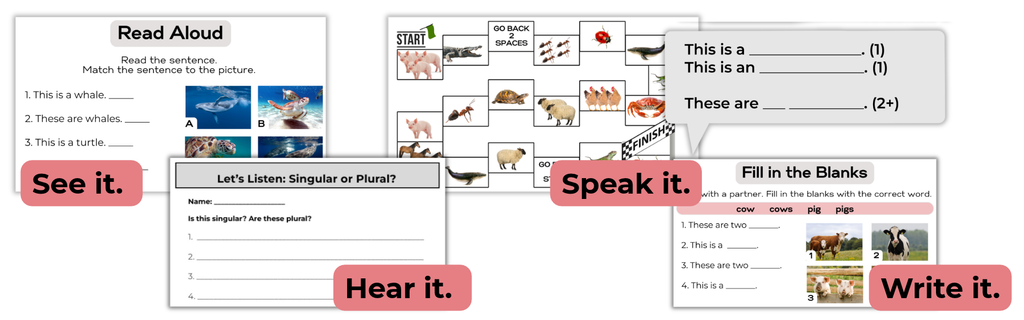
- See it. Have students read sentences that contain singular and plural nouns. Which ones are plural? Circle the -s. Match the sentences to corresponding pictures with plural nouns. If finding plural nouns in sentences is too hard, start with singular and plural words.
- Hear it. Is this word or phrase singular or plural? Begin to train students’ ears to hear the plural.
- Say it. Model the plural with an exaggerated -s (“three sister-sss”), then have students repeat it similarly.
- Write it. Those trickier forms where students need to add -es or -ies? Have them write it out. Old school methods still work for a reason.
Mistake 2: Adding the -s to Irregulars
Looks like: “The childs are outside.” “My foots hurt.”
Why it happens: You taught plural nouns too well! Just kidding. The good news is that the student has internalized this rule, but now he or she is using it all the time. The real problem is that English has irregular plurals that don’t follow rules.
🛠️ The fix:
- Match it up. Teach irregular plural nouns like child/children, man/men, woman/women, person/people, foot/feet, tooth/teeth, and mouse/mice by having students match the singular and plural words with images. This is great as a warm-up and can be brought out every couple of weeks to reinforce the concept.
- Sort it out. Give students a stack of plural nouns and have them sort by rule: add -s, -es, or -ies OR irregular without an -s sound.
- Student-made anchor chart. Give students a pile of plural noun word cards. Have them create an anchor chart with the names and drawings of irregular nouns. Keep it up as they continue to learn other English concepts.
Mistake 3: Making Uncountable Nouns Plural
Looks like: “I eat a lot of rices.” “We need the informations.”
Why it happens: Ah, the uncountable nouns in English. The tricky part is that many of these words are countable in other languages. In Spanish, for example, informaciones is correct, so “informations” feels natural to a Spanish speaker.
🛠️ The fix:
- Correct and continue. This might be controversial, but I would correct it through repeating it back and move on. If your students are beginners, trying to explain uncountable nouns will likely end up in frustration for both you and your students. I mean, this concept can easily be a week-long mini-unit in and of itself! Simply correct it, “You eat a lot of rice? Yum!” and keep going.
I have separate strategies and activity ideas for uncountable nouns, so I won’t go into it here in this blog. Students will come up against uncountable nouns later in their learning when their skills are a bit stronger, and they can understand the concept a bit more easily.
Ready-to-Teach Plurals Practice
Plural mistakes don’t disappear after one lesson. Students need to see the -s, hear the -s, and practice the irregular plural nouns before it becomes natural. And as I have told other teachers, you don’t need to aim for students to have this concept down 100%. Learning English is recursive in nature. You will naturally hit singular and plural again when you teach the verb, “to be.”
Now, if you need lessons and activities that are ready to go, my ESL Singular & Plural Nouns unit is made for newcomer and beginner secondary English learners. It gives your students the practice they need so you can spend less time planning and more time teaching.
👉 Get the Singular & Plural Nouns unit here.
Which plural mistake do you hear most in your classroom? I’d love to know!
Need more grammar strategies? Check out easy-to-implement ideas here.