

Big ELPS changes are coming to Texas classrooms. The old framework, first laid out in 2012, has shaped EB student placement, EB classroom supports, and TELPAS prep for over a decade. And now? The ELPS officially updated in 2024 finally come into effect this school year.
After spending a summer morning getting PD credit to review the new ELPS, here are the four changes that my collegues and I felt mattered the most.
1. 4 Proficiency Levels Are Now 5
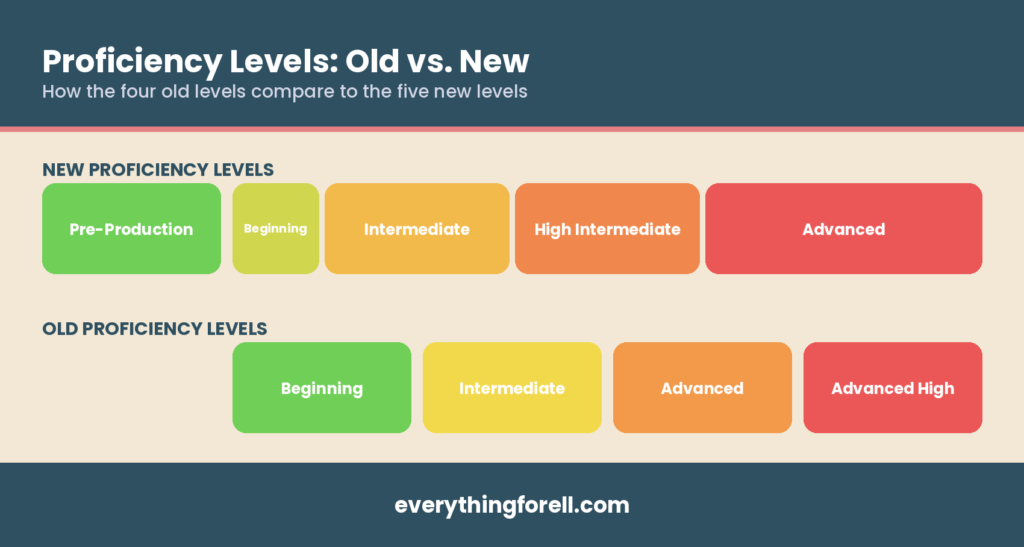
One of the biggest ELPS changes? Beginner, Intermediate, Advanced, and Advanced High expanded into five levels: Pre-Production, Beginner, Intermediate, High Intermediate, and Advanced. Let’s break this down.
The addition of pre-production was especially exciting for the high school ESL team I work with. We have had a lot of Afghan students come to us illiterate in their native language, and we noticed that they ended up being “beginners” for 2 years in a row because the old ELPS ignored that first year of hard work to become literate. So, we really love pre-production and acknowledgment of the silent period is here, seperate of beginners.
The intermediate category has also been split into intermediate and high intermediate. Advanced high is dropped, and the highest proficiency level is simply advanced. Here is a basic breakdown of the levels:
- PRE-PRODUCTION: copy, mimic, trace, and point
- BEGINNERS: native language mixed with English, high-frequency, memorized words
- INTERMEDIATE: cognates, Greek/Latin roots, high-frequency phrases
- HIGH INTERMEDIATE: high-frequency academic words, more details, sentences
- ADVANCED: academic vocabulary, complex sentences, longer written and oral production
➡️The implication: We feel creating 5 proficiency levels is a step in the right direction. It acknowledges the silent period and shows more clearly how langauge development takes time, and it is build from one skills to the next.
2. Categories Are Now Language Patterns
The old ELPS organized each domain around a handful of broad descriptors. For example, speaking had five: discourse/fluency, vocabulary, grammar, accuracy, and pronunciation.
The new PLDs break those same domains into many more, narrower “language patterns.” Speaking now has eleven categories or patterns. What stayed: discourse with 2 seperate patterns and vocabulary with 3 seperate patterns. Grammar has been replaced with Structure & Syntax and Pronunciation replaced with Register. Accuracy seems loosely replaced by three seperate Respond-to-Information patterns (responding using schemea, responding using newly acquired vocbaulary, and responding by asking questions). Added was Phonology.
This is just one of the four domains. So, if you want a bigger breakdown, I would check out my seperate blog here.
➡️The implication: there are WAY more skills here to teach and measure now. We can’t teach it all. I mean, have you seen our TEKS? 😂 But I like this. Because instead of looking at one old, general descriptor that had 5 skills built in and think, “I can’t do all that,” we can now pick one skill and focus on that. And that’s a great place to start.
3. Descriptors Are More Clear
Another one of the ELPS changes is that alongside more descriptors is more clarity. Look at this comparison of an intermediate level listener:
- OLD: usually understands simple or routine directions, as well as short, simple conversations and short, simple discussions on familiar topics.
- NEW: uses explicitly taught content-area vocabulary, cognates, or Greek and Latin prefixes, suffixes, or roots to comprehend oral classroom instruction and interactions.
Notice the difference: it names a specific WHAT, cognates and morphology, and ties it to a specific HOW, oral instruction and interactions.
➡️The implication: Across all four domains, the new PLDs consistently describe what a student does with language in an academic task, not just what they can generally understand or produce. That makes them far easier to translate directly into “I can” statements, checklists, or skill-tracking most of us are already doing for TELPAS prep.
4. ELPS for EVERYONE!
In the past, EB teachers got a general set of ELPS. We were told to incorporate them into our lessons, often times alongside with our TEKS, and basically be solely responsible for the language learning of our EB students. But now?
ELA, Math, Science, and Social Studies have a set of proficiency level descriptors written specifically for their content. That means mainstream teachers get language written for the unique skills they hit in their contents: variables and exponents in math, historical events in social studies, and cause and effect in science.
➡️The implication: For over a decade, the ELPS were something the majority of mainstream teachers weren’t touching. That was for the EB teachers. Now, I am not saying that social studies teachers should have to explain the difference between modals mustn’t and have to. What I am saying, is this:
- Focused vocabulary lists and word walls
- Oral repeating of content vocabulary
- Speaking stems and writing stems
- Visual supports in notes
- Drop-In Reading
- Quick Script listening activities
Every student benefits from a langauge rich classroom and language rich activities. Hopefully, with this change, mainstream teachers will be able to see how incorporating langauge intentionally into their classes helps support the EB population as well as the general education population.
And if you are a mainstream teacher who needs the new ELPS to post in your classroom, I have these ready-to-print and post.
- ✅ELAR (60 ELPS)
- ✅Math (55 ELPS)
- ✅Science (50 ELPS)
- ✅Social Studies (40 ELPS)
Final Thoughts
These ELPS changes show movement towards accuracy and inclusion. The five proficiency levels give newcomers their own space. The expanded language patterns replace broad categories with skills, and the clear descriptors explain how they can be implemented. Finally, content-area descriptors mean everyone is involved in supporting EBs and their language development.
What change do you agree with the most? What change do you hate? How could these updates have been done differently? I would love to hear your thoughts on these ELPS changes. Leave a comment below!